


Women of God
Jochebed, Moses’ Mother
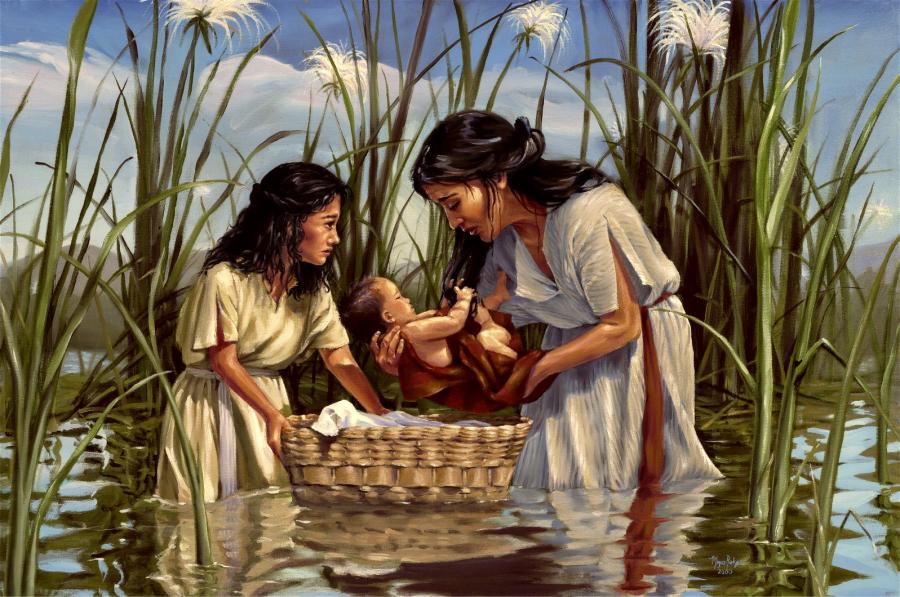
The story of Moses is a beautiful story of a leader chosen by God to rescue His people out of oppression. But would we even have the story of Moses had not Moses’ mother placed her extreme faith in God? Her story is one that shows us how God can take a sorrowful situation and still bring joy; her story shows us that God is far more powerful than ANY circumstance. Jochebed’s story is really God’s story. He uses her and Moses in a mighty way to show His glory, His power, and His sovereignty.
Jochebed’s Character
- A Levite woman who married a man of the same house (tribe).
- Became pregnant and gave birth to a son.
Exodus 2 begins like a wonderful family story. There’s marriage, the joy and anticipation of starting a family, and then the birth of a baby boy, who is described as being “fine” or beautiful and healthy (Ex. 2:2).
But reading the context of Exodus 1 and what follows in Exodus 2 shows us that this baby boy is not born under pleasant circumstances.
You see, the Jews lived in Egypt and were multiplying and expanding. After Joseph’s reign, a new king “came to power” (1:8) and grew afraid that the Jews would continue multiplying and eventually take over the land. He began to oppress the Jews with slavery and issued a decree that all newborn Jewish males be killed—“thrown into the Nile” (2:22).
*Can you even fathom the terror Jochebed must have been facing? The joy of pregnancy is taken away, replaced with the fear of losing her child. Oh, how she must have wished and prayed for a baby girl rather than a baby boy. Did she try to hide her pregnant belly from others? Did she give birth in secret? We aren’t given all the details, but we do know she gave birth to a beautiful baby boy, and the time that should have been spent nursing and doting upon and singing to her child was spent hiding him for “three months” (2:2).*
Three months of hiding from all public view. Three months of desperately trying to keep her baby quiet. Three fearful months, I’m sure, of never, ever leaving her baby’s side. And to top it all off, the next thing we are told is that after three months… “she could hide him no longer” (2:3).
*Jochebed is a mother, holding her three-month-old son, and coming to the harsh, bitter realization that she can no longer protect her baby. Living in these circumstances, it would be easy to throw up our hands and say, “There’s nothing I can do” with a sense of hopelessness and defeat.
BUT…
There was one thing Jochebed could do with hope—however small that hope seemed at the time.
*Jochebed trusted God.*
Scripture says Moses’ parents hid him “by faith”… and “they were not afraid of the king’s edict” (Hebrews 11:23).
How is it humanly possible not to be afraid when your own child’s life is in jeopardy?
Answer: It’s not humanly possible. But we know “all things are possible with God” (Matt. 19:26).
What strong faith Jochebed must have had to do what she does next. She finds a papyrus basket and covers it with tar, making a miniature, water-proof boat. Then, she places her baby inside the basket and begins what is probably the longest journey of her life to a swampy area of the Nile—a place where the reeds grow tall. And finally, Jochebed places the basket on the river…and lets go.
Not only does she let go; she leaves him there, and his sister Miriam stays close to see what will happen to him (Ex. 2:4).
*I am not a mother, but the thought of a mother having to let go of her own child, knowing the child is safer in a river rather than her own arms is so heartbreaking.*
BUT remember…
*Jochebed trusted God.*
She does not place Moses in the Nile with the expectation that the river will decide his fate; she trusts that God is in control. And as you read through the Book of Exodus, it’s clear God is indeed in control.
But still…Jochebed gave up her own child…That’s really tough…
Yes, it is difficult—perhaps one of the most difficult things a mother could ever go through. Here’s how God’s mercy can be seen even through this harsh circumstance:
God’s Mercy
- God directs the river to send Moses right to the riverbank near Pharaoh’s palace, where Pharaoh’s daughter is bathing.
- She discovers the basket, and, curiosity getting the better of her, peeks inside.
- Scripture says the baby is crying, and “she feels sorry for him” (2:6), knowing he is a Hebrew baby.
*God sends Moses to the one woman who would be able to persuade Pharaoh to spare his life.*
- When Pharaoh’s daughter asks if there is a Hebrew woman nearby who can nurse the baby, Miriam, who has watched closely after her baby brother, is able to suggest her and her brother’s own mother.
*How wonderful! Jochebed is able to hold Moses in her arms again because of the Lord’s kindness.*
A baby in a basket. A raging river. A compassionate woman who has the power to spare a child sentenced to death. And a mother who lets go of her child, places her faith in God, and is able to hold her son again. Don’t you see there’s no way this could have happened unless God orchestrated it all?
Even though Jochebed has to let Moses go a second time so Pharaoh’s daughter can raise him—even as hard as that must have been—her child remains alive and well. He is adopted by a woman who would love and care for him. And he, Moses, having never forgotten his roots, would grow into a Hebrew man appointed by God to lead God’s people to the Promised Land.
Do you think Jochebed looked at her “fine child” and sensed the Lord telling her he would grow up to be a fine man? I believe so. And Moses did grow up in God as a fine leader.
…
All because Jochebed was willing to let go and trust in God.